Chapters
- Exercise 1
- Exercise 2
- Exercise 3
- Exercise 4
- Exercise 5
- Exercise 6
- Exercise 7
- Exercise 8
- Exercise 9
- Solution of exercise 1
- Solution of exercise 2
- Solution of exercise 3
- Solution of exercise 4
- Solution of exercise 5
- Solution of exercise 6
- Solution of exercise 7
- Solution of exercise 8
- Solution of exercise 9









Exercise 1
Calculate the head of the vector  knowing that its components are
  and its tail is
 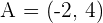 .
.
Exercise 2
Given points  and
and  , calculate the value of a if the magnitude of the vector is one.
Exercise 3
Normalize the vectors:  and
and  .
.
Exercise 4
Determine the unit vector,  , which is in the same direction as the vector
  .
.
Exercise 5
Calculate the coordinates of D so that the quadrilateral formed by the vertices:  and D; is a parallelogram.
Exercise 6
The vectors  and
and  form a basis. Express this in basis the vector
  .
.
Exercise 7
Find the value of k so that the angle that forms between  and
and  is:
is:
1 
2 
3 
Exercise 8
Calculate the value of a so that the vectors  and
and  form an angle of .
Exercise 9
If  is an orthonormal basis, calculate:
1 
2 
3 
4 
Solution of exercise 1
Calculate the head of the vector knowing that its components are and its tail is .



Solution of exercise 2
Given points and , calculate the value of a if the magnitude of the vector is one.


Solution of exercise 3
Normalize the vectors: and .



Solution of exercise 4
Determine the unit vector, , which is in the same direction as the vector .


Solution of exercise 5
Calculate the coordinates of D so that the quadrilateral formed by the vertices: and D; is a parallelogram.
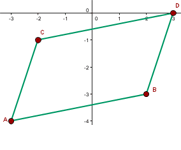




Hence, 
Solution of exercise 6
The vectors and form a basis. Express this in basis the vector .



Replacing the value of a in the second equation:



Plugging the value of b in the first equation:


Solution of exercise 7
Find the value of k so that the angle that forms between and is:
1


2


3



After solving the above equation:

Solution of exercise 8
Calculate the value of a so that the vectors and form an angle of .




Solution of exercise 9
If is an orthonormal basis, calculate:
1 
2 
3 
4 
Find more Maths tutors here on Superprof.
Did you like this article? Rate it!


 Loading...