Chapters
- Exercise 1
- Exercise 2
- Exercise 3
- Exercise 4
- Exercise 5
- Exercise 6
- Exercise 7
- Exercise 8
- Exercise 9
- Solution of exercise 1
- Solution of exercise 2
- Solution of exercise 3
- Solution of exercise 4
- Solution of exercise 5
- Solution of exercise 6
- Solution of exercise 7
- Solution of exercise 8
- Solution of exercise 9









Exercise 1
Determine the equations of the coordinate axes and the coordinate planes.
Exercise 2
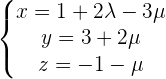
Determine the equation of the plane that contains the lines:


Exercise 3
Determine the equation of the plane that contains the point A = (2, 5, 1) and the line:

Exercise 4
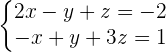
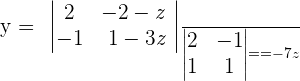
Find the intersecting point between the plane x + 2y − z − 2 = 0, the line determined by the point (1, −3, 2) and the vector 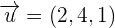 .
.
Exercise 5
Determine, in intercept form, the equation of the plane that passes through the points A = (2, 0, 0), B = (0, 4, 0) and C = (0, 0, 7).
Exercise 6
π is a plane that passes through P = (1, 2, 1) and intersects the positive coordinate semi-axes at points A, B and C. If ABC is an equilateral triangle, determine the equations of π.
Exercise 7
Find the equation of the plane that passes through the point P = (1, 1, 1) and is parallel to:
Exercise 8
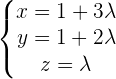
Determine the equation of the plane that contains the line  and is parallel to the line
  .
.
Exercise 9
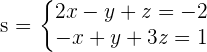
Calculate the equation of the plane that passes through the point (1, 1, 2) and is parallel to the following lines:

Solution of exercise 1
Determine the equations of the coordinate axes and the coordinate planes.
x - axis O = (0, 0, 0)  = (1, 0, 0)


y - axis O = (0, 0, 0)  (0, 1, 0)


z - axis O (0, 0, 0)  = (0, 0, 1)


XOY O = (0, 0, 0) = (1, 0, 0) = (0, 1, 0)
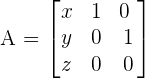
z = 0
XOZ 0 = (0, 0, 0) = (1, 0, 0)  = (0, 0, 1)
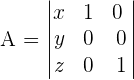
y = 0
YOZ O = (0, 0, 0) = (0, 1, 0) = (0, 0, 1)

x = 0
Solution of exercise 2
Determine the equation of the plane that contains the lines:



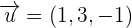

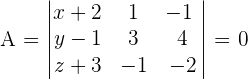
-2x + 3y + 7z + 14 = 0
Solution of exercise 3
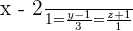
Determine the equation of the plane that contains the point A = (2, 5, 1) and the line:






Solution of exercise 4
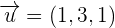
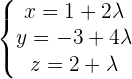
Find the intersecting point between the plane x + 2y − z − 2 = 0, the line determined by the point (1, −3, 2) and the vector 



Solution of exercise 5
Determine, in intercept form, the equation of the plane that passes through the points A = (2, 0, 0), B = (0, 4, 0) and C = (0, 0, 7).

Solution of exercise 6
π is a plane that passes through P = (1, 2, 1) and intersects the positive coordinate semi-axes at points A, B and C. If ABC is an equilateral triangle, determine the equations of π.
A = (a, 0, 0) B = (0, b, 0) C = (0, 0, c)


As the triangle is equilateral, the three line segments are equal.





Solution of exercise 7
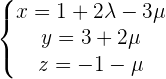
Find the equation of the plane that passes through the point P = (1, 1, 1) and is parallel to:

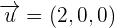


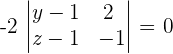


Solution of exercise 8
Determine the equation of the plane that contains the line and is parallel to the line .
The point A = (2, 2, 4) and the vector 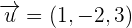 belong to the plane because the line is in the plane.
The vector 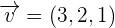 is a vector in the plane because it is parallel to the line.



Solution of exercise 9
Calculate the equation of the plane that passes through the point (1, 1, 2) and is parallel to the following lines:








Did you like this article? Rate it!

 Loading...
I’m just curious if the area between the polygon and the circumscribed circle has a name.
https://www.superprof.co.uk/resources/academic/maths/geometry/plane/orthocenter-centroid-circumcenter-and-incenter-of-a-triangle.html