Chapters
- Exercise 1
- Exercise 2
- Exercise 3
- Exercise 4
- Exercise 5
- Exercise 6
- Exercise 7
- Exercise 8
- Solution of exercise Solved Complex Number Word Problems
- Solution of exercise 1
- Solution of exercise 2
- Solution of exercise 3
- Solution of exercise 4
- Solution of exercise 5
- Solution of exercise 6
- Solution of exercise 7
- Solution of exercise 8









Exercise 1
Calculate the value of k for the complex number obtained by dividing 
Exercise 2
Find the value of k for the quotient 
1 A pure imaginary number.
2 A real number.
Exercise 3
The complex number, 2 + 2 
Exercise 4
Find the coordinates of the vertices of a regular hexagon of center origin, knowing that one of its vertices is the affix of complex number, 190°.
Exercise 5
Determine the value of b for the quotient 

Exercise 6
What are the coordinates of the point that is obtained on having turned the affix of the complex 2 + i, 90° in an counterclockwise direction about the origin.
Exercise 7
Find the coordinates of the vertices of a square of center origin, knowing that one vertex is the point (0, −2).
Exercise 8
The sum of the real components of two conjugate complex numbers is six, and the sum of its modulus is 10. Determine these complex numbers.
Solution of exercise Solved Complex Number Word Problems
Solution of exercise 1
Calculate the value of k for the complex number obtained by dividing 
For the affix, (a, b), the complex number is on the bisector of the first quadrant. The following must be met: a = b.
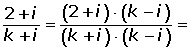

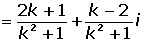


Solution of exercise 2
Find the value of k for the quotient 
1 A pure imaginary number.
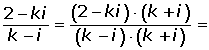

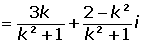


2 A real number.


Solution of exercise 3
The complex number, 2 + 2 


Solution of exercise 4
Find the coordinates of the vertices of a regular hexagon of center origin, knowing that one of its vertices is the affix of complex number, 190°.
The vertices are the affixes of the sixth roots of another complex number, z.
z = (190°)6 = 1540° = 1180°






Solution of exercise 5
Determine the value of b for the quotient 






Solution of exercise 6
What are the coordinates of the point that is obtained on having turned the affix of the complex 2 + i, 90° in an counterclockwise direction about the origin.
(2 + i) · 190° = (2 + i) · i = −1 + 2i = (−1,2)
Solution of exercise 7
Find the coordinates of the vertices of a square of center origin, knowing that one vertex is the point (0, −2).
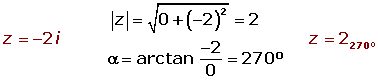
(0, −2) = −2 i = 2 270
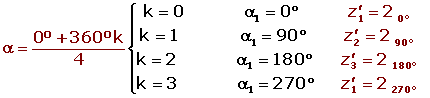
The vertices are the affixes of the quarter roots of another complex number, z.
(2270°)4 = 161080º = 163 · 360° = 160°






Solution of exercise 8
The sum of the real components of two conjugate complex numbers is six, and the sum of its modulus is 10. Determine these complex numbers.
z = a + bi = rα
z = a − bi = r−α
r + r = 10 
a + a = 6 
5² = 3² + b² b=4
r cos α + r cos (−α) = 6
5 cos α + 5 cos α = 6
cos α = 3/5
α = 53° 7' 48'' α = 306° 52' 11''
3 + 4i = 553° 7' 48''
3 − 4i = 5306° 52' 11''
Did you like this article? Rate it!


 Loading...
It is a good for me for giving some help in order to understand very well
this qwestion is necessary
l need support for complex numbers , inverse of quadratic equation, set theory