Temas





Operaciones con monomios
Efectúa las siguientes operaciones con monomios:
1 
1 Los monomios que forman la expresión son equivalentes, esto es, tienen las mismas literales con sus respectivos exponentes, por lo que el resultado se obtiene sumando sus coeficientes y se conserva las literales con sus respectivos exponentes

2 
1 Para dividir dos monomios se dividen sus coeficientes y aplicamos las leyes de los exponentes a las literales: para dividir dos elementos que poseen la misma base, se conserva la base y se restan sus exponentes
3 
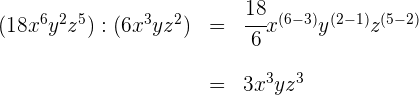
1 Para multiplicar monomios se multiplican sus coeficientes y aplicamos las leyes de los exponentes a las literales: para multiplicar elementos que poseen la misma base, se conserva la base y se suman sus exponentes

4 
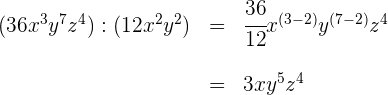
1 Para dividir dos monomios se dividen sus coeficientes y aplicamos las leyes de los exponentes a las literales: para dividir dos elementos que poseen la misma base, se conserva la base y se restan sus exponentes
5 

1 Dividimos cada término del numerador entre el denominador común

2 Aplicamos las leyes de los exponentes a las literales: para dividir dos elementos que poseen la misma base, se conserva la base y se restan sus exponentes

Suma y resta de polinomios
Dados los polinomios:



Calcular:
6 
1 Sustituimos los polinomios

2 Quitamos los paréntesis

3 Sumando términos semejantes se obtiene

7 
1 Sustituimos los polinomios

2 Realizamos el producto 

3 Quitamos los paréntesis

4 Sumando términos semejantes se obtiene
8 
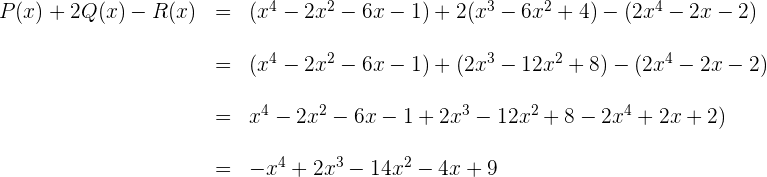
1 Sustituimos los polinomios

2 Quitamos los paréntesis

3 Sumando términos semejantes se obtiene

9 Calcula el valor de  , para que sea cierta la igualdad:

1 Quitamos los paréntesis del lado izquierdo y agrupamos sus términos semejantes

2 Quitamos los paréntesis
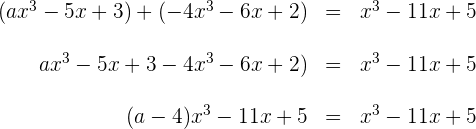
3 Igualando los coeficientes de  se obtiene
 , luego
Multiplicación de polinomios
10 Multiplicar 
1 Multiplicamos cada término del primer polinomio por el segundo polinomio
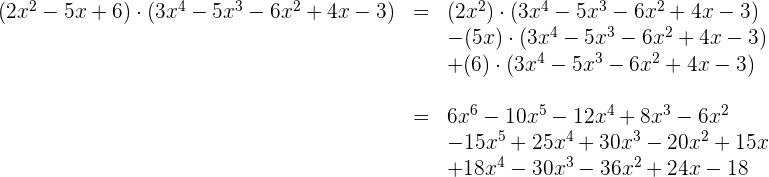
2 Sumamos los términos semejantes

Evaluación en polinomio
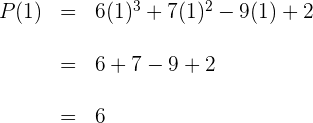
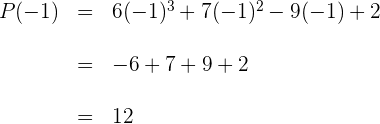
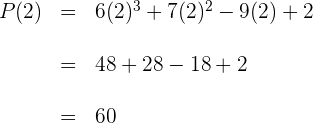
11 Hallar el valor numérico del polinomio  , para:
1 Evaluamos para 
2 Evaluamos para 
3 Evaluamos para 
4 Evaluamos para 

Producto de binomios
Calcula:
12 
1 Aplicamos la fórmula de un binomio al cuadrado

2 Realizamos las operaciones

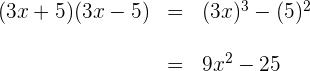
13 
1 Aplicamos la fórmula de un binomio conjugado

2 Realizamos las operaciones
¿Te ha gustado este artículo? ¡Califícalo!


 Cargando...
Apuntes es una plataforma dirigida al estudio y la práctica de las matemáticas a través de la teoría y ejercicios interactivos que ponemos a vuestra disposición. Esta información está disponible para todo aquel/aquella que quiera profundizar en el aprendizaje de esta ciencia. Será un placer ayudaros en caso de que tengáis dudas frente algún problema, sin embargo, no realizamos un ejercicio que nos presentéis de 0 sin que hayáis si quiera intentado resolverlo. Ánimo, todo esfuerzo tiene su recompensa.
El valor númerico de la expresión 7(x²-2x+5)/3 , cuando x =-2
Hola, muchisimas gracias por compartir toda esta enseñanza. Mi duda es por que no me aparece la calificación si mi respuesta es tá acertada. Un saludo
El artículo que me aparece es:
10 ejercicios de polinomios 3 ESO I
Y en ese no sale calificación.
-12X-8-3X+10=2X-9+8Y
R=4n(n-a)+8n(a-n)-n(n-5a
(2x-1)(3x-5)-6x(2÷3x-1÷2)
10x + 2x